Today we are visiting St Gilbert's Mission in Kinlochbervie. All services take place in the Ceilidh House (next door to the Health Offices).
St Gilberts Mission, Kinlochbervie, (Linked with Brora, Dornoch and Lairg) came into existence through a contact made while visiting someone from Kinlochbervie whilst they were a patient at Raigmore Hospital in Inverness.
A vibrant, warm, friendly and welcoming congregation which participates with great enthusiasm when they gather from some fair distances for the Eucharist (1982 Liturgy) on the 4th (Sun in summer / Sat in winter) weekend of each month at 6.00 pm.
Without accompaniment they sing a good portion of the liturgy, the hymns, do the reading, prayers of the people and administer the Sacrament to each other gathered as a family around the Table which is placed in the centre of the ‘Ceilidh House’ a community house in Kinlochbervie.
Let all the world in every corner sing,
My God and King!
The heavens are not too high,
His praise may thither fly,
The earth is not too low,
His praises there may grow.
Let all the world in every corner sing,
My God and King!
Let all the world in every corner sing,
My God and King!
The church with psalms must shout,
No door can keep them out;
But, above all, the heart
Must bear the longest part.
Let all the world in every corner sing,
My God and King!
Today we are visiting Holy Trinity Church in Seafield Avenue, Keith.
Holy Trinity can trace its continuous existence since the Revolution of 1688 when the priest was the Reverend James Thornton, and known to be “a strong Episcopalian”.
On 7 November 1689 he was ‘deprived of his benefice’. Ministry to the faithful continued in a number of locations by many faithful priests over the ensuing years.
It was in 1779 that Episcopalians again found a home in Keith, when a simple two roomed cottage in Bridge Street, New Keith, was used as a meeting house. In 1807 a small chapel was opened in Keith, although it was not consecrated until 1832.
In 1878 a Church Fund was opened and by 1882 the foundation stone of the present church was laid on the site next to the Parsonage in Seafield Road. This church has a unique link with the American Episcopal Church in that, in the Sanctuary is the actual chair, the “Seabury Chair”, on which Bishop Robert KiIgour (Bishop of Aberdeen, 1768-86) sat when consecrating Bishop Samuel Seabury as the first Bishop of the American Episcopal Church.
Holy, holy, holy! Lord God Almighty!
Early in the morning our song shall rise to Thee;
Holy, holy, holy, merciful and mighty!
God in three Persons, blessèd Trinity!
Holy, holy, holy! All the saints adore Thee,
Casting down their golden crowns around the glassy sea;
Cherubim and seraphim falling down before Thee,
Who was, and is, and evermore shall be.
Holy, holy, holy! though the darkness hide Thee,
Though the eye of sinful man Thy glory may not see;
Only Thou art holy; there is none beside Thee,
Perfect in power, in love, and purity.
Holy, holy, holy! Lord God Almighty!
All Thy works shall praise Thy Name, in earth, and sky, and sea;
Holy, holy, holy; merciful and mighty!
God in three Persons, blessèd Trinity!
Today we are visiting the church of St Michael and All Angels in Abban Street, Inverness.
The Church of St Michael and All Angels has its origins on the opposite side of the River Ness on the Maggot Green as the Chapel of the Holy Spirit.
In 1877 Canon Edward Medley, who had come to St Andrew’s Cathedral was struck by what he described as “the great respectability of the congregation of the Cathedral”, with “scarcely a poor person” amongst its numbers.
Canon Medley, with Bishop Eden’s encouragement., rented a thatched cottage and started church classes. Soon the adjacent cottage also had to be purchased to accommodate the many children in the area. In 1881 Bishop Eden sanctioned the title of “The Mission Chapel of the Holy Spirit”. A stone church was built in 1886, close to the Maggot Green, in Factory Street.
By the 1890’s the Maggot Green was suffering great problems of dampness caused by the river overflowing its banks. The people around the Church had moved to drier land on the other side of the River and in 1902 it was decided the Church should also move. Between 1903 and 1904 the Church was dismantled stone by stone, moved across the River Ness, where it was rebuilt and dedicated to St Michael and All Angels.
The new High Altar, with its riddel posts topped by gilded angels was designed by Ninian Comper, as is the Font, with its lofty steeple cover.
Between 1923 and 1924 extensive improvements were made to the church under the guidance of Ninian Comper. The magnificent east window of the Archangels and the Gilded Tester, both by Ninian Comper, are memorials to Canon William Lachlan Mackintosh (the first Rector - shown kneeling beside St Gabriel, in the third window).
Sir Ninian Comper’s influence is much in evidence in St Michael’s. His famous ‘signature’ of a strawberry is seen both in the bottom right corner of the right hand window and (unusually) carved on the wooden font cover.
Christ, the fair glory of the holy angels,
thou who hast made us, thou who o'er us rulest,
grant of thy mercy unto us thy servants
steps up to heaven.
Send thine archangel Michael to our succour;
peacemaker blessèd, may he banish from us
striving and hatred, so that for the peaceful
all things may prosper.
Send thine archangel Gabriel, the mighty;
herald of heaven, may he, from us mortals,
spurn the old serpent, watching o'er the temples
where thou art worshiped.
Send thine archangel Raphael, the restorer
of the misguided ways of men who wander,
who at thy bidding strengthens soul and body
with thine anointing.
May the blest mother of our God and Saviour,
may the assembly of the saints in glory,
may the celestial companies of angels
ever assist us.
Father Almighty, Son, and Holy Spirit,
God ever blessèd, be thou our preserver;
thine is the glory which the angels worship,
veiling their faces.
Today we are visiting the church of St John the Evangelist in Southside Road, Inverness.
St John’s is the oldest Scottish Episcopalian congregation in Inverness. According to the records, the Reverend Hector Mackenzie, Minister of the Parish from 1683, was ‘a staunch upholder of Episcopacy, and declined to accept the new system (presbyterianism) at the Revolution, but continued to perform his duties as Parish Minister’. On 14 October 1691, Hector Mackenzie, along with his people, were extruded from the Parish Church. Thus began the history of St John’s, although for many years following, they worshipped in secret.
At the end of the hundred years’ persecution which followed the 1688 Revolution, Episcopalians met for a time in a small Meeting House on the Maggot. The present church is the third to bear the name of St John in Inverness. The two previous buildings stood on different sites on Church Street The first, at the northern end of Church Street, was erected in 1801. The second was built on the same side of Church Street, but nearer other end, and was consecrated in 1839. The second church remained until 1903 when the greater part was demolished.
Materials from the old church were used to enlarge the Chapel of St Columba, originally a Mission of the Cathedral, which became the third St John’s in 1903.
The splendid stained glass windows behind the altar came from the second St John’s in Church Street.
St John’s most famous Incumbent was undoubtedly Dean Charles Fyvie, Rector from 1819 to 1850, whose diaries, most of which are in the National Library for Scotland, give a fascinating glimpse into Scottish life in his time.
New every morning is the love
Our wakening and uprising prove;
Through sleep and darkness safely brought,
Restored to life and power and thought.
New mercies, each returning day,
Hover around us while we pray;
New perils past, new sins forgiven,
New thoughts of God, new hopes of heaven.
If, on our daily course, our mind
Be set to hallow all we find,
New treasures still, of countless price,
God will provide for sacrifice.
Old friends, old scenes, will lovelier be,
As more of heaven in each we see;
Some softening gleam of love and prayer
Shall dawn on every cross and care.
We need not bid, for cloistered cell,
Our neighbor and our words farewell,
Nor strive to find ourselves too high
For sinful man beneath the sky.
The trivial round, the common task,
Will furnish all we ought to ask;
Room to deny ourselves, a road
To bring us daily nearer God.
Only, O Lord, in Thy dear love,
Fit us for perfect rest above,
And help us, this and every day,
To live more nearly as we pray.
Today in the gospel we hear the parable of the prodigal son.
God of mercy and compassion,
Look with pity upon me,
Father, let me call Thee Father,
'Tis Thy child returns to Thee. Refrain:
Jesus, Lord, I ask for mercy;
Let me not implore in vain;
All my sins, I now detest them,
Never will I sin again.
By my sins I have deserved
Death and endless misery,
Hell with all its pains and torments,
And for all eternity. (Refrain)
By my sins I have abandoned
Right and claim to heav'n above.
Where the saints rejoice forever
In a boundless sea of love. (Refrain)
See our Saviour, bleeding, dying,
On the cross of Calvary;
To that cross my sins have nail'd Him,
Yet He bleeds and dies for me. (Refrain)
Today we are visiting St Ninian's Church, Saltburn Road, Invergordon.
The history of Invergordon took a dramatic change in direction in 1913 when it became a permanent base for the Royal Navy. The pier, giving a deep-water berth, and the large oil tanks on the high ground above the town, also date from this period.
The revival of the Episcopalian tradition also dates from this period, but whereas the Royal Naval presence in Invergordon came to an end in 1994, St Ninian’s Church in Invergordon continues to thrive.
The last Episcopalian priest of the old tradition died in 1714, and almost exactly two hundred years later, in 1915, a Scottish Episcopalian congregation gathered again in Invergordon. The following year a church, made out of wood and metal, was erected by the Admiralty. It was sanctioned as a Permanent Mission by Bishop MacLean in 1917.
In 1989 a new church was built on the same site, incorporating trusses and the stained glass from the old Naval Church. Many gifts of furnishings were received from churches throughout the British Isles dedicated to St Ninian.
Will your anchor hold in the storms of life,
When the clouds unfold their wings of strife?
When the strong tides lift, and the cables strain,
Will your anchor drift or firm remain?
We have an anchor that keeps the soul
Stedfast and sure while the billows roll,
Fastened to the Rock which cannot move,
Grounded firm and deep in the Saviour’s love.
It is safely moored, ’twill the storm withstand,
For ’tis well secured by the Saviour’s hand;
And the cables passed from His heart to mine,
Can defy the blast, through strength divine.
We have an anchor that keeps the soul
Stedfast and sure while the billows roll,
Fastened to the Rock which cannot move,
Grounded firm and deep in the Saviour’s love.
It will firmly hold in the straits of fear,
When the breakers have told the reef is near;
Though the tempest rave and the wild winds blow,
Not an angry wave shall our bark o’erflow.
We have an anchor that keeps the soul
Stedfast and sure while the billows roll,
Fastened to the Rock which cannot move,
Grounded firm and deep in the Saviour’s love.
It will surely hold in the floods of death,
When the waters cold chill our latest breath;
On the rising tide it can never fail,
While our hopes abide within the veil.
We have an anchor that keeps the soul
Stedfast and sure while the billows roll,
Fastened to the Rock which cannot move,
Grounded firm and deep in the Saviour’s love.
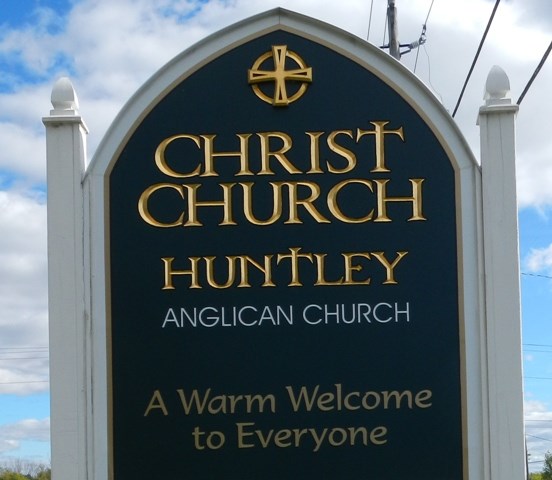
Today we are visiting Christ Church, which is located in Provost Street in Huntley. We are sure of a warm welcome!
In 1719 the Episcopalian priest in Huntly was ejected from the Parish Church and with many supporters opened a ‘Meeting House’ in “the Raws”.
Soon after, a School for Episcopalian children was established, such was the support in the area.
The Meeting House did not escape the troubles of the ‘45 Rising and, although not burned to the ground, all its contents were destroyed.
During the period of the Penal Laws services were held in secret places, usually in the open air and often at night.
The present Church was built in 1849. On the roof panels are depicted open bibles with a text and in the Chancel the Creed, Lord’s Prayer and Ten Commandments on a gilt background.
God is here! As we his people
meet to offer praise and prayer,
may we find in fuller measure
what it is in Christ we share:
Here, as in the world around us,
all our varied skills and arts
wait the coming of His Spirit
into open minds and hearts
Here are symbols to remind us
of our lifelong need of grace;
here are table, font and pulpit,
here the cross has central place.
Here in honesty of preaching,
here in silence, as in speech,
here in newness and renewal
God the Spirit comes to each.
Here our children find a welcome
in the Shepherd's flock and fold;
here as bread and wine are taken,
Christ sustains us as of old.
Here the servants of the Servant
seek in worship to explore
what it means in daily living
to believe and to adore.
Lord of all, of Church and Kingdom,
in an age of change and doubt,
keep us faithful to the gospel,
help us work your purpose out.
Here, in this day's dedication,
all we have to give, receive;
we who cannot live without you,
we adore you! We believe.